When people compare solar quotes, they look at panels, inverters and batteries. The mounting, the rails and brackets that hold everything to your roof, rarely gets a second glance. Yet it's the part that keeps your panels in place through Cape Town's winter storms and summer south-easter, and keeps the water out of your ceiling for the next 25 years. Here's how mounting works on the roofs we see most in Cape Town and Gauteng.
Why Mounting Matters
Every fixing that goes into your roof is a potential leak if it's done badly. Good mounting is matched to your exact roof type, sealed and watertight, and strong enough for the wind your home is exposed to. At MLT Power, every system uses mounting matched to your roof, all leaks are covered by our warranty, and the mounting itself carries a 10-year warranty.
Tiled Roofs
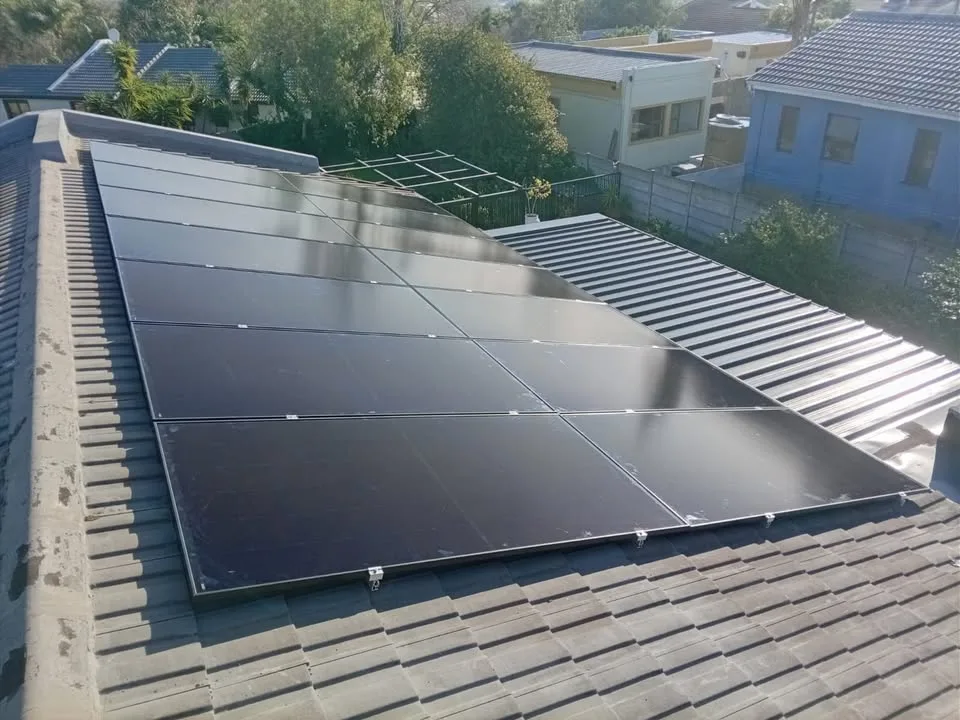
Concrete and clay tiles are the most common roofs in Cape Town suburbs, like the home pictured above. On a tiled roof, brackets fix to the roof structure beneath the tiles and come out between them, so the tiles still overlap and shed water as they were designed to. Done properly, the tiles sit back in place with nothing pushing them up, which is what keeps the roof watertight.
Corrugated and IBR Sheeting
Corrugated and IBR metal roofs are common on newer homes, outbuildings and businesses. Here the rails fix to the roof through the sheeting into the purlins underneath, and every fixing point is sealed. The photo above shows both: panels on the tiled main roof, right next to a corrugated section.
Klip-Lok Roofs
Klip-Lok is a concealed-fix metal roof, so there are no exposed screws to fix to. Mounting uses clamps that grip the raised seams of the sheeting, which means no holes through the roof at all for the panel rails.
Slate Roofs
Slate is beautiful but brittle, and it needs extra care to work on without cracking. Mounting on slate uses hardware made for slate roofs, fitted by a team that knows how to move and replace slates without damage.
Flat Roofs and Angled Frames
On flat or very low-pitch roofs, panels lying flat lose energy and collect dirt. Angled frames tilt the panels towards the sun for better production and help rain wash them clean.
Ground Mounts and Carports
Not every property has the right roof. For businesses, farms and larger homes, panels can go on a ground-mounted frame or on a solar carport, which gives you shaded parking and solar power from the same space. Both are options on our commercial systems.
Looks: All-Black Rails and Clamps
Shiny silver rails can spoil an otherwise clean install. We use all-black rails and clamps with full-black panels, so the whole array blends into the roof instead of standing out.
Paperwork Comes Too
Mounting is part of a system that has to be signed off properly. Every MLT installation includes SSEG council approval, a Certificate of Compliance and engineer sign-off.
Questions to Ask Any Installer
- What mounting will you use on my specific roof type?
- How do you seal every fixing point?
- Who pays if my roof leaks after the install?
- What warranty does the mounting carry?
- Will the rails and clamps match black panels?
If you're not sure your home is a good fit, our article on the 8 signs your property is ready for solar is a good place to start.
Get Expert Advice
MLT Power has been installing since 1986 and holds a 4.9-star Google rating from 143 reviews. We're a Tesla Premium Installer, South Africa's first installer of the full Tesla range, and a Sigenergy Certified Installer. Send us your latest electricity bill or call 087 943 2299, and we'll design your system, mounting included, with a free, fixed-price quote.
Ready to go solar?
Send us your latest electricity bill and we'll design a system and fixed price for your home or business.